Formula 1 runs on a rulebook, and in 2026 that rulebook was rewritten more completely than at any point in the sport's history.
Buried in the new power unit regulations are exactly two clauses held to a tolerance of ±0.1mm — about the width of a human hair,
Formula 1 runs on a rulebook, and in 2026 that rulebook was rewritten more completely than at any point in the sport's history.
Buried in the new power unit regulations are exactly two clauses held to a tolerance of ±0.1mm — about the width of a human hair, and the tightest lines in the document — and both of them point at the cylinder bore. Its diameter: 80mm, plus or minus a tenth. Its centreline: through the crank axis, plus or minus a tenth. Five manufacturers now machine to those two lines, and the new era's first controversy is already being fought inside them.
The Change. Everything in Formula 1 begins with the FIA's technical regulations — the document that defines what a car is before a designer draws one. For 2026 that document was rewritten across chassis and power unit simultaneously, which the sport almost never does.
Bob Bell, Aston Martin's executive director – technical, framed the scale plainly: "We haven't really had such a comparable change for a very long time."
The power unit carries the biggest changes. The MGU-H — the exhaust-energy recovery device that made the 2014 hybrids brilliant and nearly unbuildable — is gone. The MGU-K nearly triples, from 120kW to 350kW, pushing the electrical share of total power toward half.
The new kids on the track. Audi arrives as a works engine builder for the first time, Red Bull's in-house powertrains operation debuts with Ford, and Cadillac has entered the sport while conceding its own engine cannot come before 2028. Christian Horner warned the resulting cars risked being "Frankenstein" creations; Adrian Newey predicted "an engine formula at the start" — a season decided by powertrains rather than aerodynamics. The opening races have not argued with either of them.
The Tolerance. Read the 2026 power unit regulations with a metrologist's eye and a pattern emerges. The document is generous almost everywhere. Cylinder bore spacing gets ±2mm. The crankshaft's position in the car gets ±0.5mm. Engine mounting studs get ±0.2mm. Connecting rod length gets a full millimetre of window; valve head diameters get two. Most of the rulebook doesn't prescribe dimensions at all — it sets caps and floors, and lets designers exploit toward the limit. This is a choice the FIA has made.
But twice, the document tightens to ±0.1mm. Article 5.6.1: the cylinder bore diameter must be 80mm, plus or minus a tenth. Article 5.6.4: each cylinder centreline must pass through the crank axis, plus or minus a tenth. The two finest tolerances in the entire power unit rulebook both belong to the same feature — the hole where combustion happens. That is not a drafting accident. It is the FIA declaring, in tolerance form, the one geometry it refuses to let anyone design around.
So what’s new ? The 80mm figure itself is not new — it has anchored the formula since the hybrid era began in 2014. What is new is everything around it. Five manufacturers now build to it at once, two of them for the first time, under a compression ratio recut from 18:1 to 16:1, burning a fuel that combusts differently, with every kilowatt of the smaller combustion budget suddenly precious. The dimension is twelve years old. The challenge inside it is brand new.
And the fight has already started. The season's running controversy is, at heart, a dimensional dispute. The 16:1 compression ratio is verified after the working cycle — measured, in effect, on a cooled engine, because measuring a firing one is impractical. Mercedes and Red Bull Powertrains are reported to have selected connecting-rod materials whose thermal expansion raises the effective compression ratio at operating temperature: compliant at the point of measurement, worth real performance at the point of combustion. The bore itself is not in dispute — no rival has questioned anyone's 80mm. Because the bore's cross-section is fixed by regulation, the argument moves entirely to what the metal does at temperature within it — which is exactly why Gary Anderson, the veteran F1 designer, could put arithmetic on the game: over an 80mm piston, 0.1mm of height growth is worth half a cubic centimetre of chamber volume. Mattia Binotto, running Audi's programme, had already called the newcomer's position "a very difficult challenge" before the row broke. Toto Wolff's defence of Mercedes was a metrologist's defence rather than a lawyer's: "it's very clear what the regulations say" — the measurement was made as the rulebook defines it. Both men are right, and that is the point. Fix the geometry, and legality becomes a property of the measurement method; performance becomes a property of what happens between measurements.
The Instrument. A modern engine programme measures its bores at every stage of a cylinder's life. Liners are gauged after machining and after coating. Bores are verified during and after honing, where the target is not just diameter but shape — a bore can sit legally inside 80mm ±0.1 and still be the wrong geometry, because distortion under head clamping and thermal load is what the piston ring actually experiences. Development engines are torn down after every dyno campaign and gauged again, because the wear map is data: where material went missing says how combustion behaved. The new formula sharpens every one of these measurements — the fuel shifts the thermal profile that drives distortion, and the higher pressures of a 16:1 chamber land on components already at their regulatory minimum weights.
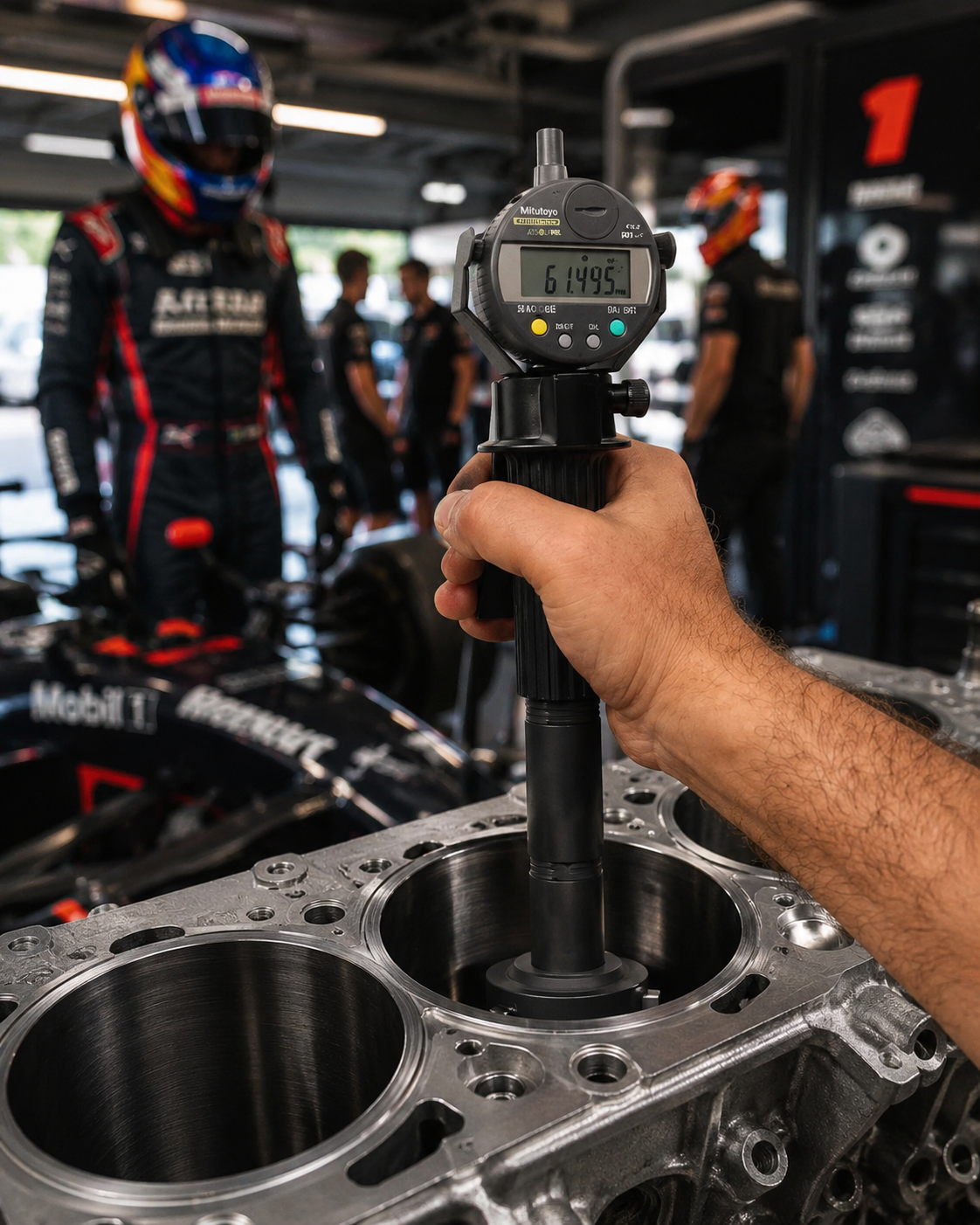
The working instrument for most of this life cycle is the three-point internal gauge — the principle behind our own Trigabore system. The scale of the job is worth stating plainly: the regulation allows about a hair's width; the performance lives in a tenth of one; the gauge must resolve a hundredth. Three-point contact self-centres in the bore, removing operator alignment from the result; micron-level repeatability is what lets an engine builder distinguish a real change from measurement noise. Temperature discipline decides the rest. A steel gauge and an aluminium block drifting apart by a few degrees will manufacture more apparent dimension than the tolerance being hunted — the same physics the compression saga turns on, run in reverse. The teams that measure at controlled temperature, against traceable standards, with setting rings certified close to working size, are running the same experiment as the FIA's scrutineers — earlier, and to tighter numbers. Zak Brown, McLaren's chief executive, admitted before the season that what unsettled him was the field: "it is just the unknown." The unknown, reduced to hardware, is two lines of ±0.1mm and what five engine builders managed to do inside them.
The Applications. Where this case meets our bench — each linked to its page.
Cylinder bore verification, 80mm ±0.1. Multi-depth readings down the bore map taper, ovality and barrel form during honing and after it — because a liner can pass the regulation and still leak power through shape. The extended-range Trigabore head covers the full regulation bore with three-point self-centring and micron-level repeatability. (These are the two finest lines in the rulebook.)
Torque-plate and assembled-state gauging. A bore measured free is a different bore once the head is clamped on. Gauging under torque-plate load, in the distorted condition the piston ring actually sees, is where self-centring contact matters most — the distortion being hunted is a handful of microns riding on 80mm. Special gauging enquiries →
Thermal growth characterisation. The season's controversy lives in the gap between the cold measurement and the firing engine. Gauging components at controlled elevated temperature, against masters certified at known temperature, quantifies real expansion behaviour — the FIA measures cold, the performance happens hot, and the teams that quantify the difference own it. Calibration and traceability →
Groove gauging in manifolds and valve bodies. Fuel rails at 350 bar, brake-by-wire hydraulics and cooling galleries are dense with seal grooves inside bores — a groove diameter that must be measured through a smaller entry bore, which no standard gauge reaches. That is a drawn-to-order anvil, from a drawing or a description, in 24 hours. Start a brief →
Small-bore precision, 2–10mm. Injector bores, pump plungers, valve guides and tappet bores carry the tightest clearances on the car, in hard and coated materials. The same three-point principle runs from a 3mm guide to the 80mm liner — one instrument family across the whole engine. The standard range →
The Reading. A rulebook reveals what it values by where it spends its precision. The 2026 regulations hand out millimetres freely and hold back tenths for one feature only — then five manufacturers, the sport's first genuine engine race in a decade, and a compression controversy all converged on that feature within months. None of it is coincidence. A specification does not remove measurement from competition; it concentrates competition into measurement, and it makes the legality of a championship-deciding design choice a question of when and how a dimension is read. The lesson travels far beyond the paddock, into every industry where a drawing is fixed and margins are contested. Find where the rulebook holds its tightest tolerance, and you have found where the game is really played.
Sources: FIA 2026 Formula 1 Power Unit Technical Regulations, Issue 4 (Arts. 5.3–5.7); Formula1.com; Mercedes-AMG F1; F1technical.net; ESPN; The Race; Motorsport.com; GPFans; RacingNews365. Quotes as attributed. Tolerance survey verified against the primary document; claims scoped to the power unit regulations.
LinkedIn post copy
Formula 1's new era is months old and the engine builders are already fighting. Mercedes and Red Bull Powertrains stand accused of gaming the 2026 rules; Audi's Mattia Binotto wants the FIA to act.
The issue: compression ratio is verified on a cooled engine, and the accused reportedly chose conrod alloys that grow at temperature — compliant when measured, faster when running.
It all traces to one dimension. The bore is fixed at 80mm ±0.1mm — a hair's width, the tightest tolerance in the rulebook. Freeze the hole, and the fight moves inside it: 0.1mm of piston growth is worth half a cubic centimetre.
The gauge that polices this must resolve a hundredth of a hair. We make those gauges.
New from The Metrologist: Pole Position Is 80mm, Give or Take a Hair.